
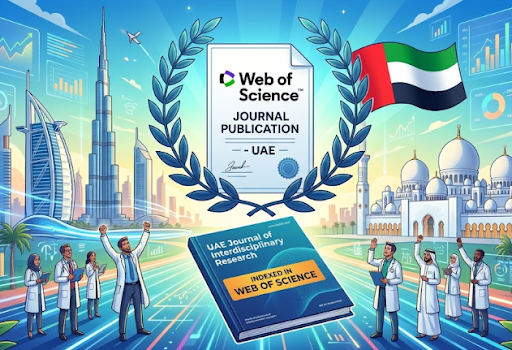
Getting a paper accepted into a Web of Science indexed journal is one of the most demanding milestones in an academic career, and nowhere is this more true than across the Gulf.
Researchers, faculty members, and postgraduate students pursuing Web of Science Journal Publication UAE face a landscape shaped by strict university requirements, competitive acceptance rates, and journals that receive thousands of submissions a year from every corner of the globe.
Whether the goal is tenure, a scholarship condition, a PhD requirement, or simple professional recognition, the path from a finished manuscript to a Clarivate-indexed publication is rarely straightforward.
This guide walks through what Web of Science indexing actually means, why it matters so much to institutions across the UAE and wider Gulf, and how researchers can approach the process with a realistic, structured plan rather than a rushed submission that risks rejection or, worse, a predatory journal.
What Does Web of Science Indexing Actually Mean?
Web of Science is the citation database and journal evaluation platform owned by Clarivate Analytics. It is not a single journal or publisher; it is a curated index that tracks citation activity, journal quality, and research impact across disciplines.
When a journal is described as “Web of Science indexed”, it means that publication has passed Clarivate’s evaluation criteria and appears within one or more of the Web of Science Core Collection indexes, most commonly the Science Citation Index Expanded (SCIE), the Social Sciences Citation Index (SSCI), or the Emerging Sources Citation Index (ESCI).
This distinction matters enormously for anyone pursuing Web of Science Journal Publication Gulf, because universities and ministries across the region do not treat all “indexed” journals equally.
A paper in an ESCI journal is viewed very differently from a paper in an SCIE or SSCI journal, and Gulf institutions increasingly specify exactly which index tier is acceptable for degree completion, promotion, or research grant compliance.
SCIE, SSCI, and the Journal Quartile System
For researchers pursuing SCIE Indexed Journal Publication Help, it helps to understand that SCIE covers the natural sciences, engineering, medicine, and technology.
SSCI Journal Publication Services, by contrast, apply to the social sciences, including education, business, psychology, and law. Both indexes rank journals into quartiles, Q1 through Q4, based on impact factor within their subject category.
High Impact Factor WoS journals sitting in Q1 or Q2 are the most sought after and, unsurprisingly, the most competitive. Many Gulf universities, particularly in the UAE and Saudi Arabia, now require faculty and doctoral candidates to publish specifically in Q1 or Q2 journals rather than simply “any Web of Science journal”.
This is where WoS Q1 and Q2 Journal Support becomes essential, since targeting the right quartile from the outset saves months of wasted submission cycles to journals that will not satisfy institutional requirements.
Why the UAE and Wider GCC Have Raised the Bar
Universities across the UAE, Saudi Arabia, Qatar, Kuwait, Bahrain, and Oman have invested heavily in research output over the past decade as part of broader national strategies to build knowledge economies. This has translated into much stricter university publication guidelines GCC. It is now common for institutions to require the following:
- A minimum journal quartile (commonly Q1 or Q2) for PhD completion
- Publication exclusively within the Clarivate Master Journal List, rather than journals that merely claim indexing
- A specified minimum number of Web of Science publications before promotion to associate or full professor
- Proof of indexing status verified directly against Clarivate’s own database rather than a journal’s self-reported claims
This last point trips up a surprising number of researchers. Predatory and low-quality journals frequently claim Web of Science or Scopus indexing on their websites when no such indexing exists.
Verifying a journal against the Clarivate Master Journal List before submission is a non-negotiable first step, and it is one of the most common gaps we see in manuscripts that arrive at Gulf Paper Publishing after a rejected or withdrawn submission elsewhere.
The Realistic Timeline for Web of Science Publication
One of the most persistent misconceptions among first-time authors is that submission equals near-term publication. In reality, the timeline for a Web of Science indexed journal typically includes the following:
- Manuscript preparation and formatting to the target journal’s specific style guide, reference format and structural requirements
- Initial editorial screening, where a significant proportion of submissions are desk-rejected before reaching peer review
- Peer review, which for reputable journals can take anywhere from six weeks to six months depending on the field and the availability of qualified reviewers
- Revisions, often across two or three rounds, before an editor is satisfied
- Acceptance, typesetting and online-first publication, followed eventually by formal issue assignment
This is a demanding process, and it is precisely why researchers under time pressure, whether from a scholarship deadline, a visa condition, or a graduation requirement, look for fast track Web of Science publishing pathways.
A shortened timeline achieved through proper journal selection, rigorous manuscript preparation, and prompt author response to reviewer comments is entirely different from a shortcut that compromises the paper’s legitimacy.
Handling Journal Peer Review Revisions Effectively
Journal peer review revisions are where many otherwise strong manuscripts fail. Reviewers commonly raise concerns about methodology clarity, insufficient literature contextualisation, statistical rigour, or the novelty of the contribution relative to existing work.
A well-structured response to reviewers, addressing each comment point by point with clear reference to the revised manuscript, dramatically improves the odds of eventual acceptance. Authors who treat the revision stage as a formality rather than a genuine opportunity to strengthen the paper are far more likely to face a second or third rejection.

Who Needs Web of Science Publication Support Across the Gulf
The demand for WoS Journal Publishing Services UAE wide spans several distinct groups, each with different pressures:
- PhD candidates at Gulf universities are frequently required to have one or more Web of Science publications, often in Q1 or Q2 journals, as a condition of thesis submission or viva scheduling.
- Faculty members pursuing promotion need a sustained publication record that satisfies increasingly specific institutional benchmarks, particularly at research-intensive universities in the UAE and Saudi Arabia.
- Government and healthcare researchers, particularly across Saudi Arabia’s expanding research infrastructure, need Web of Science publication help KSA institutions can verify against national research quality frameworks.
- Independent researchers and clinicians publishing outside a formal academic appointment often need the most guidance, since they lack institutional research offices or co-author networks familiar with the submission process.
What Clarivate Journal Publishing Services Should Actually Include
Genuine Clarivate Journal Publishing Services GCC researchers can rely on it but should never promise guaranteed acceptance, since no legitimate service can override an independent peer review process. What responsible support includes is the following:
- Journal selection and matching, aligning the manuscript’s scope, methodology and audience with journals genuinely indexed at the required quartile
- Manuscript structuring and writing support, ensuring the paper meets international scholarly conventions for argumentation, evidence presentation and citation with the help of editing and proofreading services
- Language and technical editing, addressing clarity and precision without altering the underlying research or findings
- Formatting to journal-specific submission guidelines, covering reference style, figure and table presentation, and word count compliance
- Response drafting support during peer review, helping authors construct clear, respectful and thorough replies to reviewer feedback
- Plagiarism and integrity screening prior to submission, since similarity issues are one of the most common causes of desk rejection
This is the model Gulf Paper Publishing follows: supporting the researcher’s own work through every stage of research paper publication, never fabricating findings, never guaranteeing outcomes that depend on independent peer reviewers, and never steering authors toward journals that only claim indexing without genuine Clarivate verification.
Choosing Between Journals: A Practical Framework
When comparing potential journals for paper publication, researchers should weigh several factors beyond quartile ranking alone:
- Scope alignment. A technically excellent paper submitted to a journal whose scope does not match is likely to be desk-rejected regardless of quality.
- Historical acceptance rate and typical review timeline. Some Q1 journals in niche fields move faster than mid-tier journals overwhelmed with submissions.
- Article processing charges, where relevant, since costs vary enormously between fully open access journals and hybrid or subscription models.
- Editorial board composition, which offers a strong signal of a journal’s genuine standing within its field, independent of marketing claims made on the journal’s own website.
Researchers should also be cautious of journals that email unsolicited invitations to submit, promise unusually fast review with no explanation, or waive their fees to a striking degree.
These are common warning signs associated with predatory publishers exploiting the pressure researchers feel around academic writing deadlines and career milestones. Gulf Paper Publishing ranks in the top 10 for thesis writing and publishing services due to our strong commitment to professionalism, putting an end to exploitation.
Building a Publication-Ready Manuscript From the Start
Many of the delays researchers experience are avoidable with better preparation before first submission. Strong research paper manuscripts share several traits regardless of discipline:
- A clearly stated research gap and contribution, established early rather than buried in the discussion section
- Methodology described with sufficient detail for replication, a growing requirement across Clarivate-indexed journals
- Results presented with appropriate statistical rigor and transparent reporting of limitations
- A literature review that engages critically with recent work rather than simply listing prior studies
- Consistent formatting and referencing aligned to the target journal from the first draft, rather than reformatted repeatedly across multiple rejected submissions
Manuscripts prepared this way, whether for a first-time submission or a resubmission after rejection elsewhere, move through editorial screening and peer review considerably more smoothly.
Frequently Asked Questions
SCIE (Science Citation Index Expanded) covers natural sciences, engineering, technology, and medicine, while SSCI indexing focuses on social sciences. Choose the appropriate index based on discipline, and confirm indexing status via Clarivate’s Master Journal List before submitting research.
The most reliable method is to search Clarivate’s Master Journal List directly, as journal websites may falsely advertise indexing status. Check your university’s approved journal list for further validation.
Timelines for Clarivate-indexed journals range from six months to over a year for acceptance, affected by editorial screening, peer review, and revisions. Expedited reviews exist but can be longer for Q1 journals.
No service can guarantee journal acceptance. Legitimate support enhances submissions through journal matching, formatting, editing, and guidance, maintaining research integrity while avoiding predatory practices.
Move Your Research Forward
Publishing in a genuinely Clarivate-indexed journal is a demanding process, but it is also a well-understood one once broken down into its component stages: correct journal selection, rigorous manuscript preparation, realistic timeline expectations, and disciplined handling of peer review revisions.
For researchers pursuing Web of Science Journal Publication UAE and across the broader Gulf, the difference between a smooth publication journey and a frustrating cycle of rejections usually comes down to preparation done properly the first time, rather than reactive fixes after a desk rejection.
Gulf Paper Publishing works alongside researchers, faculty, and postgraduate students at every stage of this process, from initial journal selection through to final response letters during peer review, always in support of the researcher’s own original work.
Start your publication journey with a clear plan. Contact Gulf Paper Publishing today for a manuscript assessment and journal matching consultation tailored to your field and target quartile.