
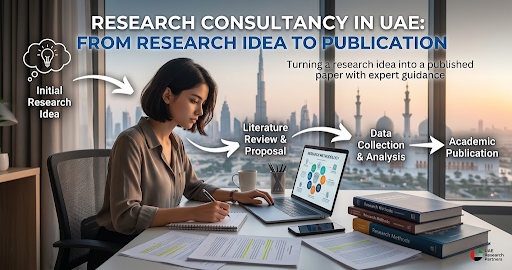
A nurse in Dubai notices something odd about patient recovery times and wonders if anyone has studied it properly. A banking professional in Abu Dhabi keeps hearing the same customer complaints and thinks there might be a paper in it.
A postgraduate student stares at a supervisor’s comment that just says “needs more focus” and has no idea where to even begin fixing that.
This is the ordinary, slightly chaotic starting point for almost every research project, and it’s exactly why Research Consultancy in UAE has become such a common search term among students and academics across the Emirates.
Getting from that first messy idea to an actual published paper isn’t really about talent. It’s about having the right structure at the right moments, and knowing which decisions matter early versus which ones can wait.
That’s the gap research consultant UAE services are meant to fill. Over the next few sections, you’ll go through what these services actually do and how the process tends to be administered.
What Does a Research Consultant Do?
Usually, an academic research consultant starts with three basic questions: Is your topic achievable in the time duration you’ve got? Is the gap you’ve spotted a real one? and will your methodology actually get you somewhere worth publishing?
They’ll also pick up on things students rarely catch themselves, objectives that don’t quite match the research questions, or a framework that sounds impressive but has nothing measurable behind it.
It’s closer to editing than inventing. But it’s the kind of academic research consultancy that quietly prevents a six-month detour later.
This is the reason why a platform like Gulf Paper Publishing has built a name for itself among researchers trying to turn a rough idea into something publishable
When Should You Hire a Research Consultant?
There isn’t one single “right” moment to reach out for help, but a few points in the process tend to matter far more than others.
The Right Moments to Bring Someone In
The best moments to bring in research guidance services UAE are usually right after your topic gets a first nod of approval, before your data collection instruments are finalised. A quick review at each of these points tends to catch problems while they’re still cheap to fix.

What if You’re Already Past These Points?
If you’re already past several of these stages and things still feel shaky, that’s fine too. Research support services UAE aren’t only for the start of a project, they’re just more effective the earlier you use them.
What Does Research Consultancy in Gulf Paper Publishers UAE Cover?
People often assume “research consultancy” means one thing, to just help with writing a proposal. In practice it’s broader than that, and it usually covers several connected pieces of a study rather than one isolated task.
Topic Selection and Proposal Guidance
This is where a broad, ambitious idea gets narrowed into something you can actually finish. A student who wants to “study the impact of AI on the UAE economy” will, after this stage, usually end up with something far more specific and far more answerable, like the adoption of AI-based credit scoring among mid-sized UAE banks.
Research Design and Methodology Support
Once the topic is settled, the next question is how you’ll actually study it. This is core research methodology consultancy territory, based upon deciding between qualitative, quantitative, or mixed methods based on what your question genuinely requires, not what feels less intimidating.
Hypothesis and Framework Development
This is where variables, theory, and expected outcomes have to integrate together properly. Too often, a framework looks great on paper but has nothing to do with how the data will actually be collected. Better to identify that timely than after months of work.
Data Analysis Advisory
Even a well-designed study can fall apart at the analysis stage if the wrong statistical test is applied or the results aren’t interpreted in a way that ties back to the original questions. Good advisory support here is less about crunching numbers and more about making sure the numbers actually say something.
Benefits of Research Consultancy
- A clearer, sharper research question from the very start
- Less back-and-forth with supervisors over methodology disagreements
- Better alignment between your study design and your target journal
- Fewer desk rejections caused by formatting or structural gaps
- More confident, better-interpreted data analysis
- A smoother run at Scopus or Web of Science submission
Research Questions and Methodology: Getting the Foundation Right
Everything else in a research project rests on two decisions made early: what you’re actually asking?, and how do you plan to find the answer? Get either one wrong, and you end up rebuilding months later. Here’s how to think through both properly.
Universities and journal publications often have their own expectations around methodology, and getting research methodology support in UAE from someone who is an expert in this field, can save weeks of avoidable revision.
Writing a Question That Actually Holds Up
“How does technology affect business?” tells a reviewer nothing. “How has mobile banking adoption affected customer trust among UAE retail bank users aged 25–40” tells them exactly what you’re studying, on whom, and why it matters.
Before locking in your question, it helps to ask a few blunt things about it. Is the gap real, or is it just a gap in what you’ve personally read so far? Would a reviewer get the point of your study right away, or would they have to guess? If you’re hedging on any of these, the question isn’t ready yet, go back and narrow it further.
Letting the Question Choose the Methodology
If your study is trying to understand experiences, perceptions, or the “why” behind something, qualitative research consultancy approaches, interviews, case studies, focus groups, tend to fit better.
If you’re testing relationships between variables or trying to measure something at scale, quantitative research consultancy methods like surveys and statistical modelling make more sense.
A growing number of studies use both, and that’s where mixed methods research support earns its keep, letting qualitative insight explain patterns that numbers alone can’t fully account for.
How to Improve Research Quality Before Publication?
By the time a paper is close to submission, most researchers have read it so many times they can no longer see its problems clearly. That’s normal, and it’s exactly the kind of steps for writing and submitting a research paper in UAE, Gulf Paper Publishing UAE services provide.
| Quality Check Area | What to Look For | Why It Matters |
| Research Question Alignment | Does the discussion section actually answer the original question | Reviewers reject papers that drift off-topic |
| Methodology Clarity | Could another researcher replicate your method from the description alone | Peer reviewers judge rigour before they judge results |
| Literature Currency | Are most sources recent and directly relevant | Outdated references quietly undermine credibility |
| Data Analysis Accuracy | Do the statistical tests actually fit the data type | Misapplied tests are a common cause of desk rejection |
| Formatting and Referencing | Does it match the target journal’s exact guidelines | Formatting mismatches are one of the leading causes of rejection |
| Academic Tone and Grammar | Is the writing formal, clear, and free of ambiguity | Weak language can bury genuinely strong findings |

How to Select the Right Journal for Your Research?
A lot of journals sound like a fit and just aren’t. Check indexing before you get attached to a journal too. If one’s promising fast or guaranteed acceptance, that’s worth pausing on. Real peer review takes time.
How to Prepare Research for Scopus or Web of Science?
Getting into an indexed journal takes more than solid findings. Scopus journal publication services and research consultancy typically involves matching your manuscript against the specific formatting and structural expectations of your shortlisted journal.
This makes sure your literature review draws from current, indexed sources, and tightens your methodology section enough to satisfy reviewers who tend to be more particular.
Web of Science, run by Clarivate, is generally considered more selective than Scopus, so aligning with its standards early, rather than after a rejection, saves a lot of time.
Common Research Challenges Faced by UAE Researchers
They’re just common enough that timely research consultancy in the Gulf, such as the support provided by Gulf Paper Publishing, can often save significant time and effort well before submission day.
- Struggling to narrow a broad topic into something specific enough to defend
- Genuine uncertainty over qualitative versus quantitative versus mixed methods
- Limited access to reliable statistical guidance for more complex datasets
- Not knowing how to tell a legitimate journal apart from a predatory one
- Formatting and referencing errors that quietly lead to desk rejection
Once a researcher starts using structured Research Consultancy in UAE guidance at these earlier stages, most of the panic around deadlines tends to fade on its own.
How Research Consultancy Supports Successful Publication
Good consultancy doesn’t stop once the proposal is approved. It’s meant to carry a study all the way through, long after most students assume the “help” part is over.
Carrying the Study Through a Ready Manuscript
Research publication consultancy stays involved well past the proposal stage, refining the topic where needed, tightening the methodology, checking the analysis holds up, and aligning the final draft with what the target journal actually expects. This is the stretch where a lot of good research quietly loses momentum without someone keeping it on track.
Getting Past the Revise-and-Resubmit Loop
Paired with research paper publication support like formatting, editing, and proofreading help responding to reviewer comments, this is usually what separates papers that get published from ones stuck bouncing between revisions for months. A clear response to reviewer feedback, rather than a rushed one, tends to make the difference here.
Why Choose Gulf Paper Publishing for Your Research Consultancy in UAE?
Full-Journey Academic Support
Gulf Paper Publishing doesn’t hand you back a single edited document and call it done. The support runs from topic refinement and proposal review through methodology planning, framework development, and data analysis direction, all the way to journal submission and reviewer response guidance.
Experienced, Subject-Matched Consultants
With a sizable team of academic research consultants working across the UAE, Saudi Arabia, Qatar, Kuwait, Oman, and Bahrain, projects are matched with someone who actually knows the subject field, not a generalist skimming your topic for the first time.
Confidential and Ethical Process
Your topic, proposal drafts, supervisor feedback, and unpublished data stay confidential throughout. For anyone working in a competitive or sensitive research area, that matters more than it might sound.
Practical, University-Aligned Guidance
The advice is built around what UAE and GCC universities actually expect rather than generic templates, covering research support for UAE universities from Master’s level through to DBA and PHD research.
Applications of Research Consultancy Services at Gulf Paper Publishers:
| Application | Who It’s For | What It Typically Involves |
| Dissertations | Master’s and MBA students | Capstone projects, topic refinement, methodology planning |
| Proposals | DBA and PhD scholars | Full-length thesis development, proposal structuring |
| Publications | Faculty members | Journal articles and conference papers |
| Medical | Clinical researchers | Studies requiring ethical approval alignment |
| Business | Applied researchers | Case studies, technical reports, business research |
Ready to Take Your Research Forward?
There’s no fast track from a rough idea to a published paper. You need a sharp research question, a methodology that suits it, analysis done properly, and a manuscript that’s truly ready for the journal you have in mind.
For students and academics across the Emirates, working with an experienced research consultancy in UAE team, Gulf Paper Publishing being one, is often what separates a project that stalls halfway through from one that quietly gets published.
If you’re just starting out or stuck somewhere in the messy middle, reaching out for structured guidance is not a decision you’ll regret.
Frequently Asked Questions
Academic support covering topic selection, methodology, data analysis, and publication guidance for students and researchers.
Master’s, MBA, DBA, and PHD students, plus faculty members preparing papers for journal submission.
Yes, they advise on the right tests, sample sizing, and how to interpret your results.
Right after your topic gets initial approval, ideally before the full proposal is written.
Yes, their team supports preparation for Scopus, Web of Science, and ISI indexed journals.
Not at all, it supports Master’s, MBA, DBA, and faculty-level research too.
Yes, journal selection support includes checking indexing status and editorial legitimacy.
Yes, structured guidance cuts down on desk rejections and strengthens the overall paper.